
How to Track a Feed → Wake → Sleep Routine Without Living by the Clock
A practical way to track feeds, wake windows, and sleep so you can see your baby's rhythm without turning every day into a rigid schedule.
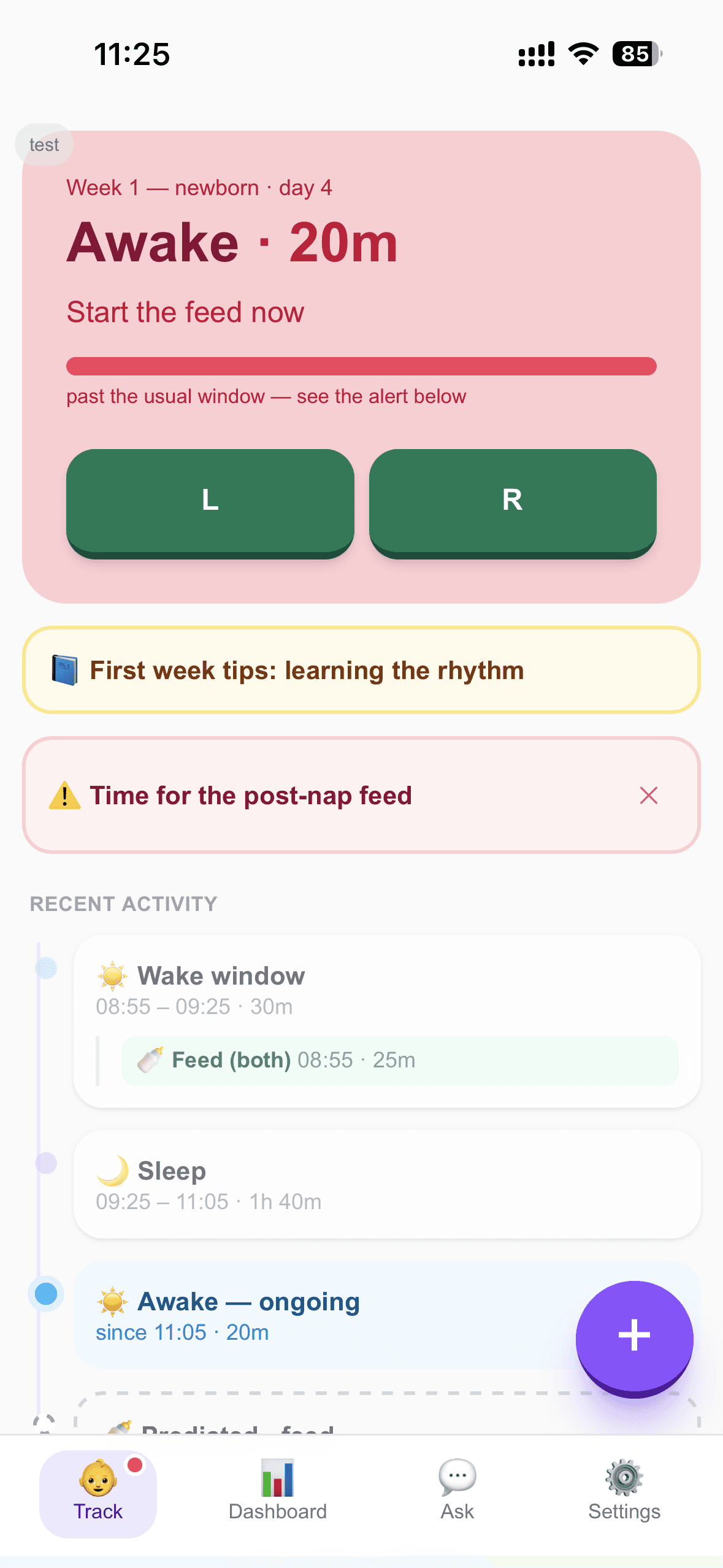
A Feed → Wake → Sleep routine is easier to understand when you can see the whole day together. The goal is not to force every feed or nap into an exact minute. It is to remember what happened, notice a developing rhythm, and make the next decision with better context.
A useful log should reduce mental load. If tracking starts to feel like another job, record less. A few consistent details are usually more helpful than a perfect record that is impossible to maintain.
What the cycle is trying to show you
The basic sequence is simple: baby feeds, has an age-appropriate period of awake time, and then sleeps. Real days will include short naps, cluster feeding, appointments, contact naps, and feeds that happen earlier than expected. Those variations are information, not failures.
Instead of asking whether the day matched a perfect schedule, ask what tends to happen after a full feed, how long your baby is comfortably awake, and whether short naps or difficult evenings repeat at similar points in the day.
The minimum useful log
Start with only the information that helps you make the next decision. You can always add more later.
- Feed start and finish, plus breast side or bottle details when useful.
- The time baby wakes, including the start of the day and the end of each nap.
- The time sleep begins and ends.
- A short note only when something unusual may explain the day, such as travel, illness, or a missed nap.
Keep your baby's cues ahead of the clock
A prediction is a prompt to pay attention, not an instruction to delay care. The CDC notes that babies communicate hunger and fullness through movements and sounds, and that crying can be a late hunger sign. If your baby shows hunger cues, feed your baby even when the log suggests the usual interval has not passed.
The same principle applies to sleep. A timer can help you notice that a wake window is getting long, but your baby's behavior and your pediatrician's individual guidance take priority over an app or a generic range.
Review patterns once a day, not after every event
During the day, use the log as memory: when was the last feed, which side was used, and how long has baby been awake? Later, take one calm look at the timeline. Repeatedly checking averages can make normal variation feel like a problem.
After several days, look for broad patterns. You may notice that one wake window is regularly longer, that a short feed often precedes an early wake-up, or that the final nap is changing. Treat these as questions to explore, not proof that one event caused another.
How Babywise App approaches the routine
Babywise App puts feeds, wake time, naps, and nights on one shared timeline. It shows the current state, offers an age-aware prediction of what may come next, and lets two caregivers work from the same record. The dashboard summarizes recent patterns without requiring a spreadsheet.
The app is free on the App Store. It is designed as a practical companion for parents who are already interested in a Feed → Wake → Sleep rhythm, not as medical advice or a replacement for reading your baby's cues.