
What to Track With a Newborn: A Simple Feeding, Sleep and Diaper Log
A low-stress newborn tracking guide for feeds, sleep, diapers, weight, and caregiver handoffs, including what you can safely skip.
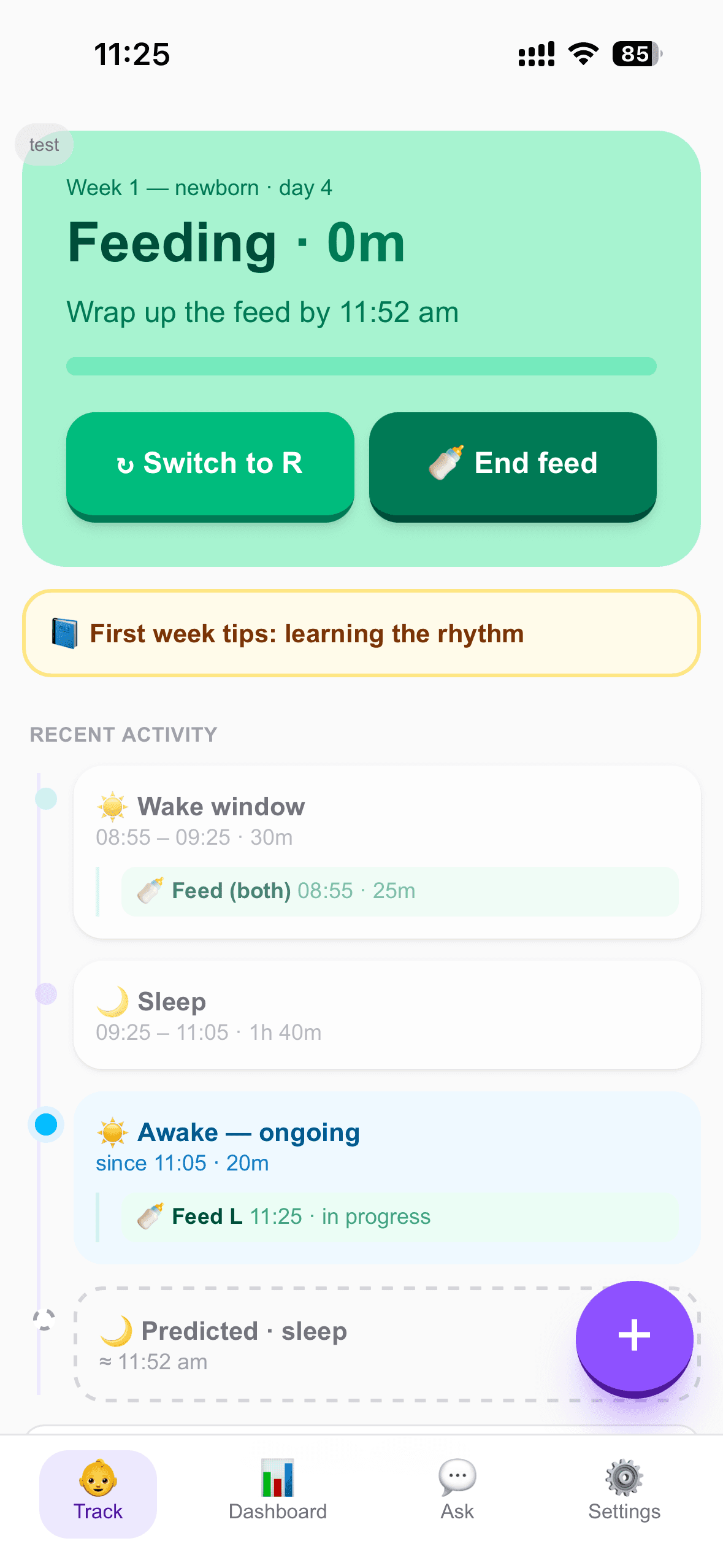
Newborn care contains dozens of tiny facts that are hard to remember when you are sleeping in short stretches. A log can answer practical questions such as which side you last nursed on, when the bottle started, or whether your partner already changed the diaper.
You do not need to record every possible detail. The best newborn log is the smallest one that helps your family communicate and gives your pediatrician useful context when you have a concern.
Begin with feeds
For breastfeeding, record the start time, duration, and side. For bottles, record the start time and amount if your care team has asked you to monitor it. If a feed is interrupted, an approximate entry is still more useful than abandoning the log because it is not exact.
A schedule must never override hunger cues. The CDC lists early cues such as hands moving toward the mouth, turning toward the breast or bottle, lip movements, and clenched hands. If feeding or weight gain concerns you, contact your baby's clinician rather than trying to solve the issue from app averages.
Add sleep when it becomes useful
Some families record sleep from the first day. Others wait until life is a little less chaotic. Both approaches are reasonable. Sleep logging becomes useful when you want to remember when baby woke, compare daytime naps with nighttime stretches, or hand care to another person without reconstructing the day from memory.
Safe sleep matters more than any schedule. The American Academy of Pediatrics advises placing babies on their backs on a firm, flat sleep surface without loose bedding or soft objects. A tracking app cannot determine whether a sleep environment is safe.
Use diapers and weight for context, not diagnosis
A simple wet or dirty diaper entry may be enough. Add color, consistency, or a note only when your clinician has asked for that information or something seems unusual. Weight is best treated as a longer-term trend discussed with a healthcare professional, not a number to react to after every home measurement.
If your baby is difficult to wake, feeding poorly, producing fewer wet diapers than your care team expects, or otherwise worrying you, contact a healthcare professional promptly. Do not wait for an app prediction or AI response.
Make caregiver handoffs effortless
A shared timeline is most helpful at 2 a.m., when one caregiver takes over and neither person wants a meeting. The incoming caregiver should be able to see the last feed, current wake or sleep state, recent diaper, and any note that genuinely changes care.
Use separate accounts when possible rather than sharing a password. Both caregivers should be able to correct an accidental entry, and the timeline should update for everyone without exporting or texting screenshots.
What you can skip
Skip fields you never use, detailed notes about ordinary events, and constant comparison with an ideal day. Tracking should make care easier. If it increases anxiety, hide optional categories, review less often, or pause and discuss your concerns with your care team.
Babywise App keeps Feed, Wake, and Sleep at the center and makes diapers and weight optional. It also supports two caregivers, timeline corrections, and CSV export when you want your own copy of the history.